Summary
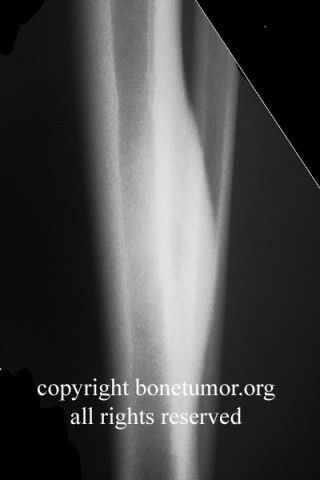
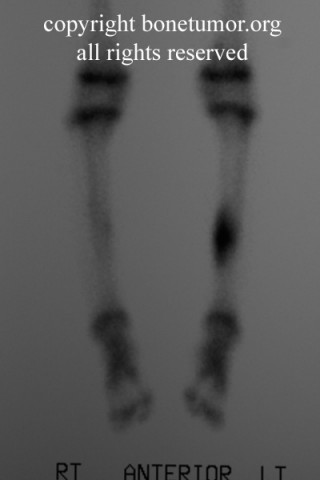
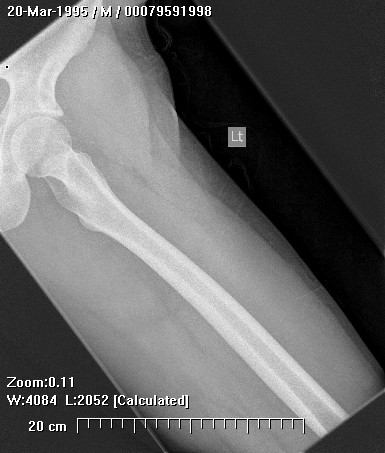
This disease was described by Leri and Joanny in 1922. It is a rare, non-hereditary lesion.
Complete Information on this Tumor
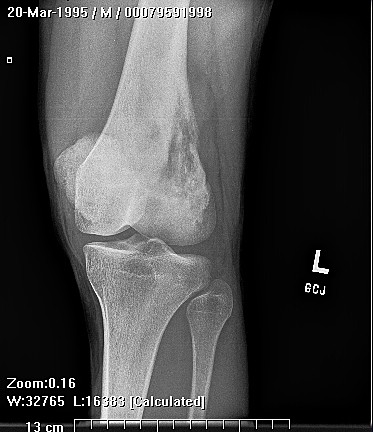
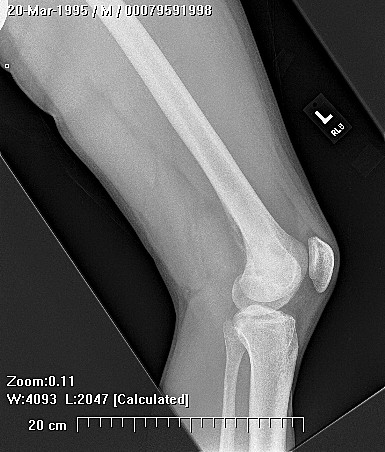
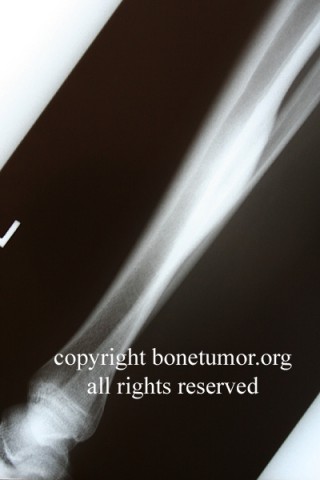
This disease was described by Leri and Joanny in 1922. It is a rare, non-hereditary lesion. The name is derived from the greek melos "limb" and rhein "to flow". Patients with meloreostosis may have associated cutaneous and soft tissue lesions such as vascular malformations, neurofibromatosis, hemangioma, arterial aneurysms, linear scleroderma, tuberous sclerosis, hemangiomas, and focal subcutaneous fibrosis. The cause of meloreostosis is unknown, but one theory proposed is that the lesion arises from an abnormality of the sensory nerve of the affected sclerotome (Murray et al Skel Rad 1979 4: 57-71). A sclerotome is a zone of the skeleton supplied by an individual spinal sensory nerve, and represents a basic unit of vertebral embryonic development. One bone may be involved (monostotic) or several bones may be involved (polyostotic), or one limb may be affected in several, usually contiguous areas (monomelic). The lesions may affect only one side of a bone or group of adjacent bones, and these bones are usually related to the same sclerotome or group of sclerotomes. Isolated cases of malignancy have been reported in association with melorheostosis, one osteosarcoma and one malignant fibrous histiocytoma. At least one death has been reported due to complications from this disease. The cause of death was not related to the bone abnormalities; the patient developed resistant pleural effusions due to associated vascular malformations.
Adults generally complain of pain, joint stiffness, and progressive deformity. In children the condition affects mainly the bones of the extremities and pelvis, and may result in limb length inequality, deformity, or joint contractures. Joint contractures may be accompanied by extraosseous bone formation.
Cortical lesions are progressive and may result in narrowing of the medullary canal and stenosis of an adjacent lumen, foramen, or of the spinal canal. Motor or sensory nerves may be compressed and become symptomatic, such as the suprascapular nerve in the scapular notch. The cortical hyperostosis may extend into nearby joints and cause loss of motion.
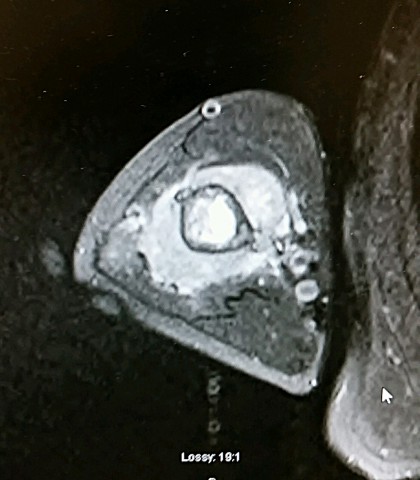
Extensive soft tissue masses may develop, most of which are adjacent to the involved bone, but some may be unconnected to the bone. The soft tissue masses become more ossified over time. Heterogeneous signal intensity is seen on MR imaging due to the mixture of osseous, fibrous, adipose, and cartilagenous tissue these contain. The soft tissue lesions enhance with IV gadolinium. An erroneous dignosis of sarcoma is possible, particularly when the soft tisue lesion is unmineralized.
Greenfield and Arrington, Imaging of Bone tumors, Lippencott, 1995
Judkiewicz et al , Skel. Rad. 2001: 30:447-453
Kalbermatten et al, Progresive melorheostosis in the peripheral and axial skeleton.. Skel. Rad. 2001: 30:48-52