Explore Real Clinical Cases

Explore real cases with stories and pictures

Explore Our On-Line Learning Content

Enhance your knowledge of tumors and their management

unknown tumor - metastatic
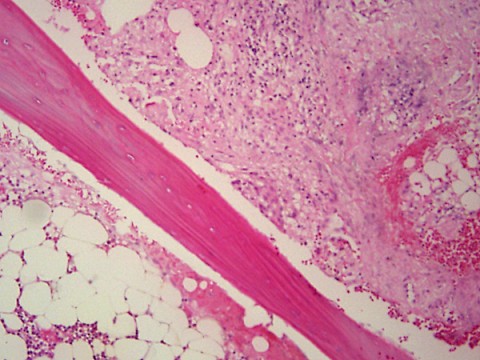
A 43 year old woman with breast cancer presents with severe hip pain and inability to walk

Case Identification
Case ID Number: 
20091117AA
Benign/Malignant: 
unknown
Clinical case information
Case presentation: 

A 43 year old woman with a history of breast cancer with bone metastasis presents with severe hip pain and inability to walk. Plain radiographs and a CT image of her right proximal femur are shown.

Radiological findings:: 
The patient has been active and her general condition is quite good. You have decided that the patient has the appropriate indications for operative intervention. What procedure do you choose?
Treatment Options:: 
The failure rate associated with fixation devices used to stabilize metastatic lesions of the proximal femur has been published . What is the liklihood of failure of a proximal femoral plate and compression screw device based on this report? What is the reported overall failure rate at 60 months for femoral fixation?
Special Features of this Case:: 
Here is a abstract of a publication that addresses this reconstructive challenge: Clin Orthop 1990 Feb;(251):213-9 Metastatic bone disease. A study of the surgical treatment of 166 pathologic humeral and femoral fractures. Yazawa Y, Frassica FJ, Chao EY, Pritchard DJ, Sim FH, Shives TC. Department of Orthopedics, Mayo Clinic, Rochester, MN 55905. A retrospective study of the surgical treatment of 166 metastatic lesions of the humerus and femur in 147 patients was performed. There were 106 women and 41 men whose average age was 62 years. Two-thirds of the patients were treated for complete fractures, while one-third were treated for impending fractures. Breast, lung, and kidney carcinoma accounted for the majority of the primary lesions. One-half of the patients died within nine months of surgery, while one-quarter were alive 19.1 months after surgery. The patients with breast cancer had the best prognosis, while the patients with lung cancer had the worst. The probability of implant failure increased linearly with time to 33% at 60 months. The probability of failure for the femoral lesions was greater, with 44% at 60 months. The average survival in the patients with failed fixation in the femoral lesions was 34.5 months with a mean interval to failure at 17.7 months. The failure rate was high (23%) in proximal femoral lesions treated with a compression screw or nail plate. Common reasons for failure included poor initial fixation, improper implant selection, and progression of disease within the operative field. Bone cement augmentation should be used with the fixation device when possible. Complications due to hip-screw cut-out from the head may also be reduced by applying bone cement around the screw threads.

A 73-year-old man with right hip pain and prostate cancer

Case Identification
Case ID Number: 
20090708NB
Benign/Malignant: 
Benign
Clinical case information
Case presentation: 

The patient is a generally active 73-year-old gentleman who is retired. He has prostate cancer that has been well controlled. Now, he has right hip pain and lesions in the acetabulum and proximal femur.

Radiological findings:: 
On both sides of the right hip, along with joint space narrowing and bone-on-bone contact, there are well defined cystic lesions, with sclerotic rims, which abut the joint on both sides. MRI scan the scan shows extensive abnormality in the right hip and acetabulum and supraacetabular region as well as the right femoral head. There was a cystic focus, joint space narrowing, and perilesional edema. The cystic lesions have a well defined dark rim.
Laboratory results:: 
The patient's prostate cancer is currently staged T3, N0, with suspicion of metastatic disease. PSA 19 at the time of treatment. Current PSA is 1.3.
Differential Diagnosis: 
Subchondral cyst versus metastasis or new primary malignancy.
Treatment Options:: 
Please see our page on subchondral cyst.
Special Features of this Case:: 
To differentiate between subchondral cyst and a true bone tumor or a metastatic cancer deposit in bone, look for the following features: 1) The lesion is right next to the joint. Careful examination of the radiographs may reveal an actual communication between the joint space and the cyst cavity. If doubt about the nature of the lesion exists, a fine cut CT scan on the area may allow this communicating opening to be seen and help establish the true diagnosis. 2) There are radiographically visible signs of osteoarthritis, usually moderate but sometimes mild, seen in the adjacent joint. If these are entirely absent, the diagnosis should be reconsidered. In the hip, these lesions occur the acetabulum in women with "shallow hips" which can be determined by calculating the center-edge angle. The shallow hip is prone to early degenerative changes and cysts are common in these patients. 3)There is usually a sclerotic rim around some areas of the lesion. The zone of transition is narrow, whereas in a metastatic lesion a sclerotic rim is absent and the zone of transition may be poorly defined. 4) The lesion should be fluid filled, and this may be seen best on MRI images. 5) These lesions are rarely progressive, and pathological fractures are rare.
Image Reference: 
Syndicate content