Explore Real Clinical Cases

Explore real cases with stories and pictures

Explore Our On-Line Learning Content

Enhance your knowledge of tumors and their management

central

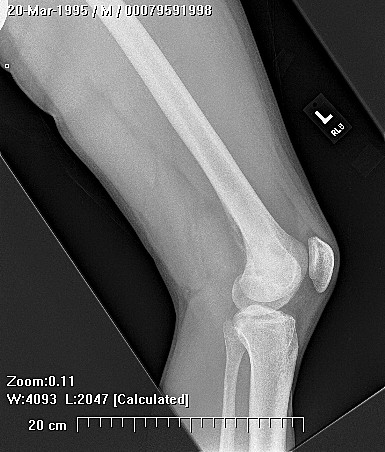
51 year old with knee pain

Case Identification
Case ID Number: 
20090721KP
Periosteal Reaction: 
absent
Benign/Malignant: 
unknown
Clinical case information
Case presentation: 

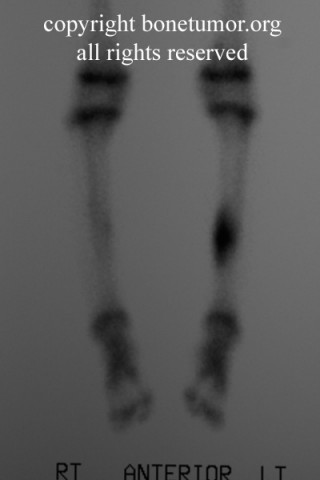
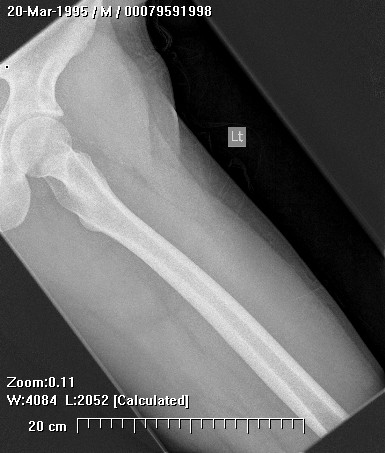
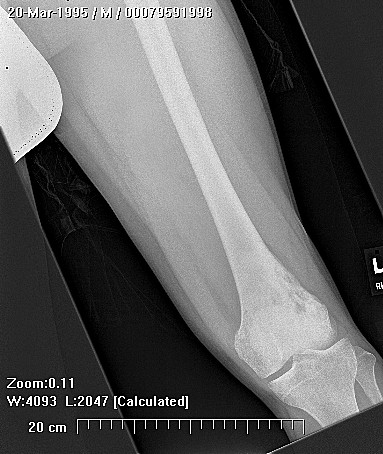
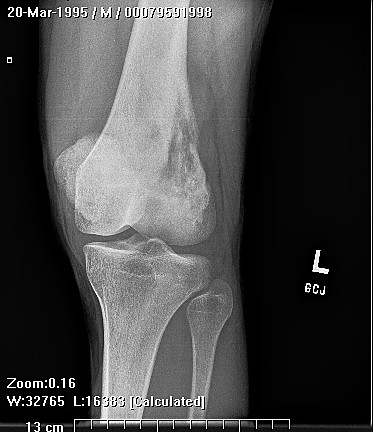
A 51 year old woman presents with left knee pain for 1 year. There has been no previous history of disease, injury, or exposure.

Radiological findings:: 
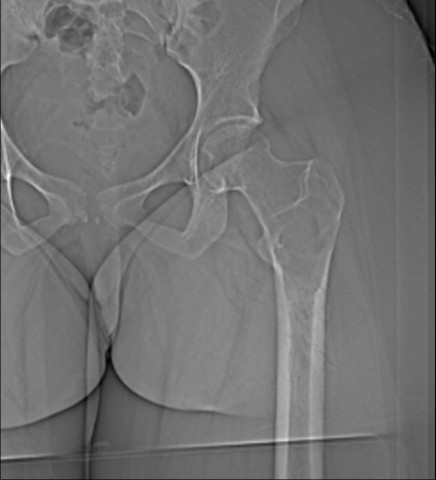
A lytic lesion is seen in the distal femur. Plain xrays, bone scan, and MRI are performed. Images are shown at left.
Laboratory results:: 
None of significance.
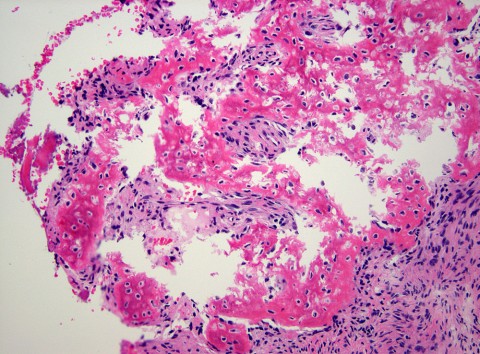
Pathology results:: 
Biopsy results are shown.
Special Features of this Case:: 
This large tumor presents a significant risk of pathological fracture. How should this be addressed?
Image Reference: 

A 10 year old boy with pain in the left clavicle

Case Identification
Case ID Number: 
20100422LC
Benign/Malignant: 
unknown
Clinical case information
Case presentation: 

A 10 year old male had pain in the left shoulder for six months. An initial radiograph was interpreted as showing a non-displaced fracture. A slight fever was noticed which diminished after treatment with antibiotics.

Radiological findings:: 
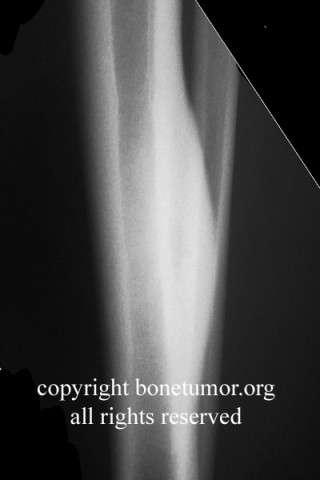
The initial radiograph was interpreted as showing a non-displaced fracture. After the symptoms continued, a new radiograph was performed, which showed marked changes in the left clavicle.
Laboratory results:: 
On admission the patient's temperature ws 37.5°C. His WBC was 8.5 (4.5 - 9.5) with a normal differential. His electrolytes and liver function tests were normal, and the alkaline phosphatase was 738 (up to 740). The erythrocyte sedimentation rate was 52 (up to 15) and the protein C was 0.72 (up to 0.5). On examination his clavicle was enlarged and slightly tender. There were no neurovascular or cutaneous abnormalities. The motion of the left upper extremity was unimpaired.
Differential Diagnosis: 
Construct a differential diagnosis that has at least three entities; including a benign tumor, a malignant tumor, and a non-tumorous condition.
Image Reference: 

A 25 year old pilot with arm pain

Case Identification
Case ID Number: 
20111227PA
Periosteal Reaction: 
absent
Benign/Malignant: 
unknown
Clinical case information
Case presentation: 

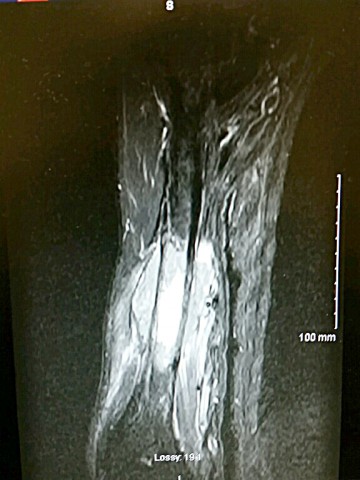
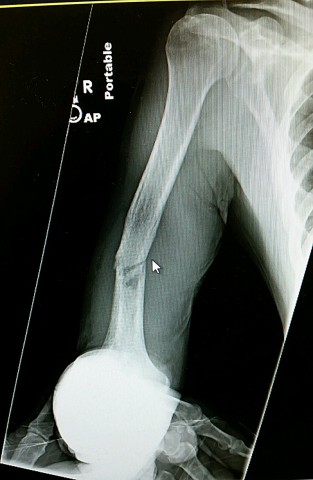
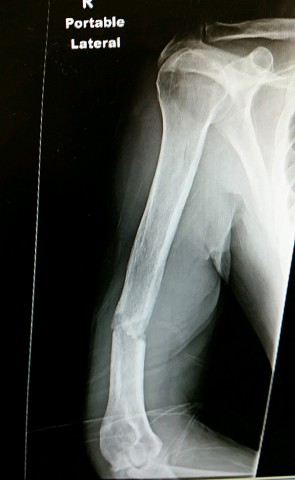
This healthy male was treated for an expansile lesion of the left humeral diaphysis at age 13. At age 25, pain recurred, and xrays show a large new lesion with weakening of the bone.

Radiological findings:: 
Xrays from the three episodes of treatment are shown, with the most recent xrays shown last. In 1999 at age 12-13 there was an expansile lesion with an incomplete pathological fracture, and bright signal on MRI. Hydroxyapatite cement was used to fill the lesion. In 2006 xrays showed the HA graft material was still present, there was no expansion of the bone or weakening, but an MRI showed persistant mild signal change. In 2011 when the pain recurred, xrays showed a large new expansile lesion in the humerus. The new lesion is proximal to the the HA cement which was placed in 1999. There is no periosteal reaction. The bone is slightly expanded, and the cortex thinned but not violated.
Laboratory results:: 
The lesion was sampled at surgery, and based on findings of benign tissue, it was curetted and packed with PMMA cement. At surgery, there was slightly turbid, yellow fluid under mild pressure in the lesion, which was send for cytology. Curettings revealed significant amounts of tan cellular material, but also revealed a thin membrane with a shiny, synovial appearance covering portions of the lesion cavity.
Differential Diagnosis: 
The original pathological material from 1999 was described as "fibroproliferative lesion" but no definite diagnosis was given. Is this an NOF? Is it a recurrent UBC with fibrous proliferation? Or something else?
Further Work Up Needed:: 
The lesion was sampled, and based on findings of benign tissue, it was curetted and packed with PMMA cement. At surgery, there was slightly turbid, yellow fluid under mild pressure in the lesion, which was send for cytology. Curettings revealed significant amounts of tan cellular material, but also revealed a thin membrane with a shiny, synovial appearance covering portions of the lesion cavity. Pathology is pending
Pathology results:: 
See images
Special Features of this Case:: 
This lesion does not fit any classic diagnosis. UBC does not typically occur in the diaphysis, or contain large amounts of tissue, and NOF does not fit the xray appearance, behavior, or the fact that the lesion was fluid filled. FD can undergo cystic change, but usually demonstrates bone formation. None of these lesions typically regrow dramatically as this lesion seems to have done, in a young adult 12 or 13 years after initial treatment.

A 32 year old from Nicaragua with a large tumor in the knee

Case Identification
Case ID Number: 
20120102FJ
Benign/Malignant: 
Benign
Clinical case information
Case presentation: 

FJ is a 32-year-old father of two small children who presented to the local hospital in Nicaragua with a painful tumor in the left distal femur. A biopsy was made and the diagnosis was giant cell tumor. The patient was told that he needed an amputation, but he refused.

Radiological findings:: 
The patient did not wish to have an amputation and he returned home. Several months later he presented again, this time with severe pain. He was no longer able to walk or move due to the pain. The tumor had enlarged and there was an unstable pathological fracture of the distal femur. The x-rays show a destructive, lytic lesion, with no bone formation or matrix which had completely destroyed the distal femur. A displaced and unstable pathological fracture was also noted. It was uncertain if the osteopenia in the proximal tibia was due to disuse or due to extension the tumor.
Laboratory results:: 
No laboratory examinations ordered.
Differential Diagnosis: 
The diagnosis had been confirmed by pathological examination to be giant cell tumor.
Pathology results:: 
Confirmed as giant cell tumor.
Treatment Options:: 
In developed countries, this patient would be treated with a distal femoral replacement, either using a mega prosthesis or a distal femoral allograft. However, these resources were not available, and the only remaining option was some type of amputation. Fortunately, the patient had healthy, normal bone and soft tissue below the knee that could be saved. As a result, the patient was a good candidate for rotationplasty. A rotationplasty is a modified amputation where the distal portion of the leg is saved rather than being cut off. This procedure has the potential to give the patient a far better functional result than an above-knee amputation.
Special Features of this Case:: 
Due to the limited local resources, some sort of amputation was the only option. A rotationplasty is a modified amputation where the distal portion of the leg is saved rather than being cut off. The leg and ankle are turned 180 degrees, so that the strong and healthy ankle joint can function as a knee joint. This allows the patient to use shorter prosthesis and walk crutch-free. However, to achieve this goal, the patient still faces a long period of rehabilitation and a complex prosthetic fitting. Because of his extremely limited resources and the limited resources of his country, a donated prosthesis will be required. Special fitting and re-configuration of the socket portion of the prosthesis will be required so that the patient can get back on his own two feet.
Syndicate content