Explore Real Clinical Cases

Explore real cases with stories and pictures

Explore Our On-Line Learning Content

Enhance your knowledge of tumors and their management

unknown tumor - soft tissue

A 25-year-old man with persistent swelling after an ankle sprain.

Case Identification
Case ID Number: 
20091117AG
Benign/Malignant: 
unknown
Clinical case information
Case presentation: 

The patient is a 25-year-old male who has a history of an ankle sprain some months ago. He has had persistent swelling in the ankle. He is working as a painter. There is pain in the ankle in the mornings and after workouts.

Radiological findings:: 
The patient is generally healthy and takes no prescription medicines or supplements. He has no allergies to medicines. He gives no history of previous surgery or illnesses. The rest of the review of systems is negative in detail. There is no significant family history. Examination of the foot shows there is a soft, slightly mobile, soft tissue mass in the anteromedial portion of the right ankle that measures approximately five by 3 cm and appears to be about 1 cm thick. It is nontender. There is synovitis and swelling in the ankle generally. There is pain and tenderness along the course of the posterior tendon behind the medial malleolus. The range of motion of the ankle is slightly reduced. The overall alignment and arch of the foot is preserved. The neurovascular status is normal. There is no skin lesion and no cafe au lait spots are seen. No popliteal or inguinal lymphadenopathy is palpated.

A lawyer with a mass on the leg for 18 months

Case Identification
Case ID Number: 
20090813LM
Periosteal Reaction: 
absent
Benign/Malignant: 
unknown
Clinical case information
Case presentation: 

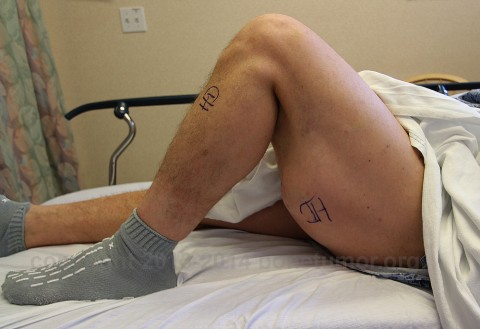
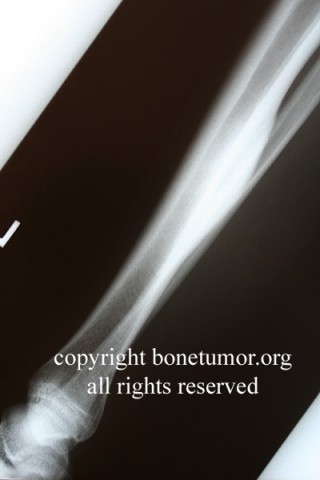
A 61 year old attorney has noticed a superficial mass on the left left for about 18 months. It was totally painless but sometimes caused itching. The mass was initially thought to be a varicose vein, but slowly and progressively increased is size. On examination, a definite mass can be seen and felt.

Radiological findings:: 
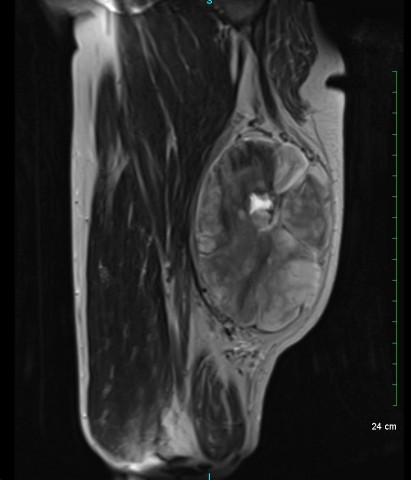
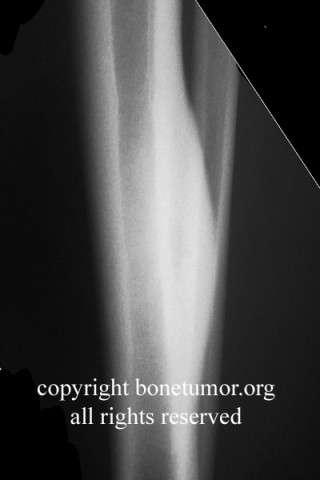
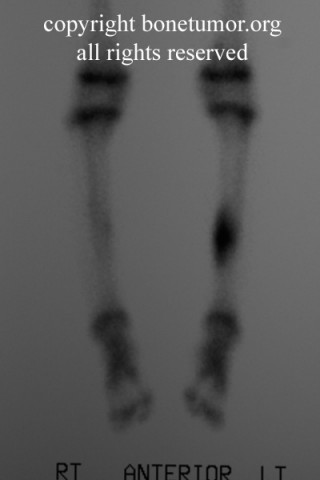
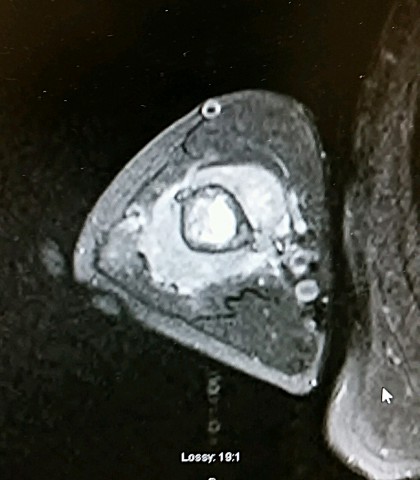
The MRI shows a multilobular lesion apposed to the cortex of the anterior distal tibia, without obvious bony involvement, with "indeterminate" signal characteristics (low signal on T1, high signal on T2). The signal intensity is somewhat variegated within the mass, and is not consistent with a fluid-filled process such as a cyst.
Differential Diagnosis: 
This mass is "indeterminate" on MRI. However, the clinical and radiological features allow the potential for malignancy to be assessed in a qualitative way. What factors have a bearing on the potential for malignancy of this lesion?

A mass on the big toe for more than 10 years

Case Identification
Case ID Number: 
20110901TY
Benign/Malignant: 
unknown
Clinical case information
Case presentation: 

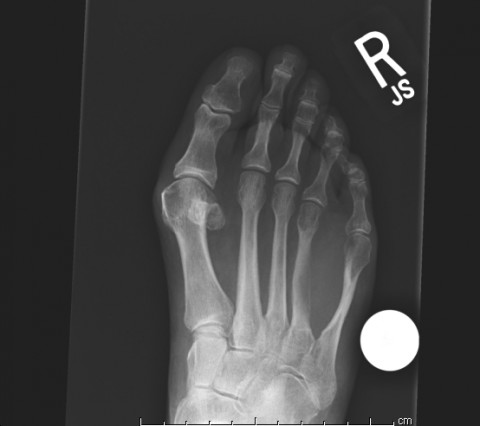
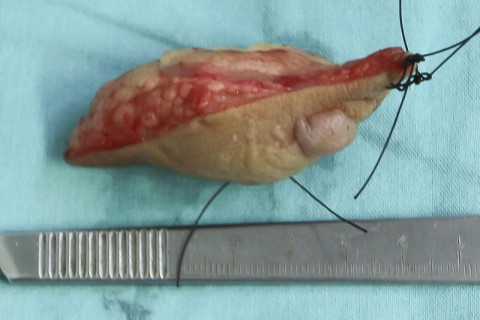
This 69 year old male has a mass on the lateral aspect of the great to for at least 10 years. The mass has now gotten large enough to be troublesome. Elysian is not painful. It is fleshly, moderately soft.

Radiological findings:: 
The lesion is completely radio loosened. There is no calcification. The density appears to be higher than that of lipid. MRI findings show a well circumscribed Mass, T1 dark, T2 intermediate leash and that appears to have a normal tissue plane between the Mass and the adjacent first distal phalanx.
Laboratory results:: 
none ordered
Differential Diagnosis: 
There are a large number of benign soft tissue lesions. Lipoma and variants of lipoma, fibrous lesions, tumors that arise from nerve cells or nerve sheath cells, and tumors of vascular origin are among the possibilities.
Further Work Up Needed:: 
The concerns here are the potential for cancer, which exist despite the very slow growth, and the skin loss that will result from excision. Although local coverage may be possible, a split thickness skin graft should be considered. It does not appear that a local flap or rotational flap will be necessary.
Treatment Options:: 
Excision with local or split thickness skin graft coverage is planned.

A massively swollen arm with tumors

Case Identification
Case ID Number: 
20090722MS
Periosteal Reaction: 
absent
Benign/Malignant: 
Malignant
Clinical case information
Case presentation: 

The patient is 53 and at around age 30, he developed a mass in his left neck. Since then he has had development of innumerable masses in the left arm, the left chest wall, and the left shoulder.

Radiological findings:: 
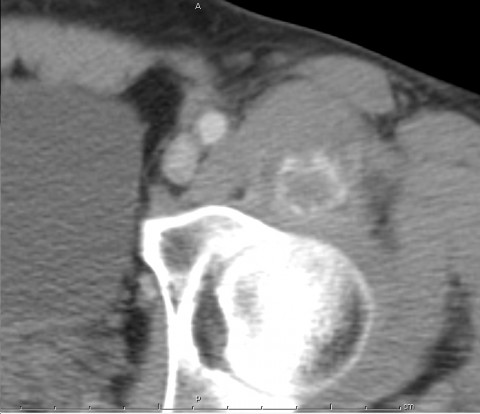
Prior to the developed mass at age 30, he did not have any arm or shoulder problems. He has had by his estimation, 23 surgeries. The lesions would become larger and larger and he would call the doctor who would arrange to remove the most symptomatic ones. His last surgery was about 13 years ago. The patient is generally healthy. He does not have hypertension, diabetes, heart disease, and he has never been a smoker. He has had chemotherapy, which he describes as given in pill form, type unknown, as well as 4,500 cGy radiation therapy to the left chest, shoulder, and arm. Recently, he has had onset of lymphedema. This seems to have developed in the last three to six months. He has had development of large tortuous veins on the chest wall and the proximal portion of the arm. Recently his symptoms have been worsening rapidly. The pain in the arm is unrelenting. The arm has become a useless, painful burden to him. He would like to have the arm amputated. On the chest wall, there are dilated veins and erythema. However, there are no individual cutaneous tumors or hairy dark patches of skin. Clinical photos are shown. The patient carries his arm in a makeshift sling. He has no useful motion of the arm. It is grossly swollen. There are multiple scars, as well as a thoracotomy scar. There are multiple palpable firm masses within the arm. The arm is exquisitely tender to the touch, and the dilated veins and areas of the chest wall adjacent to the arm are also quite tender. There is an MRI available. There are multiple nodular masses within the left upper extremity. Xrays show pathologic fracture of the humerus and extreme lytic destruction of the bone.
Treatment Options:: 
Given what you know, what treatment options are appropriate for this patient?
Image Reference: 
Syndicate content