Explorar Casos clínicos

Estudiar casos reales de tumores óseos, incluyendo la historia real y las imágenes.

Únase a la discusión

Únete a la discusión en nuestro foro en línea.

located in multiple bones

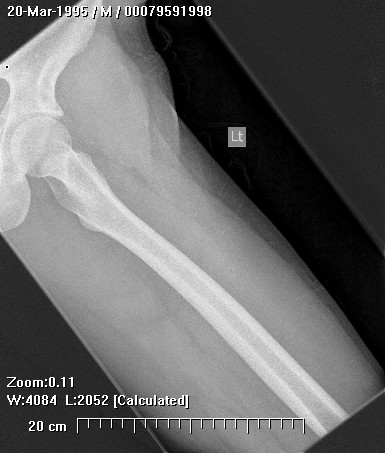
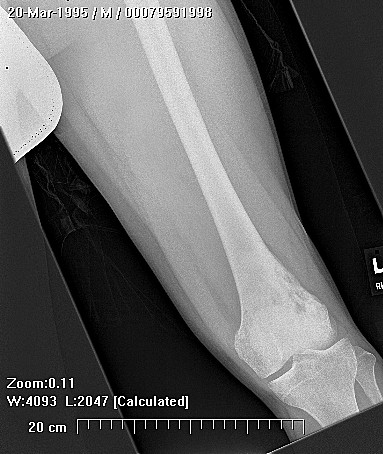
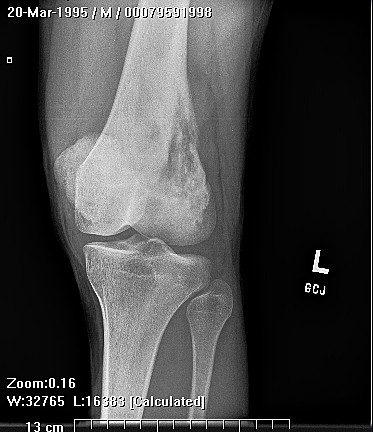
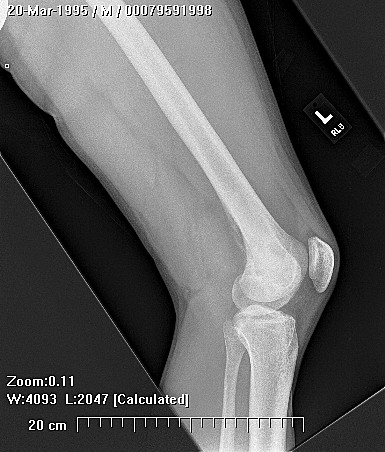
A man with multiple tumors causing stiff joints

Case Identification
Case ID Number: 
20090727SJ
Benign/Malignant: 
unknown
Clinical case information
Case presentation: 

A 39 year old man had a history of pain and progressive loss of motion of the left hip and knee.

Radiological findings:: 
Radiographically, the lesions show undulating cortical hyperostosis which has the appearance of flowing candle wax. There are also soft tissue masses which are mineralized. The femor lesions show narrowing of the medullary canal. The cortical hyperostosis extends across or nearly across joints and causes loss of motion. Extensive soft tissue masses may develop, most of which are adjacent to the involved bone, but some may be unconnected to the bone. The soft tissue masses become more ossified over time. Heterogeneous signal intensity is seen on MR imaging due to the mixture of osseous, fibrous, adipose, and cartilagenous tissue these contain. The soft tissue lesions enhance with IV gadolinium. An erroneous dignosis of sarcoma is possible, particularly when the soft tisue lesion is unmineralized.
Special Features of this Case:: 
What is the diagnosis?

A woman with right knee pain

Case Identification
Case ID Number: 
20101001KP
Benign/Malignant: 
unknown
Clinical case information
Case presentation: 

A very pleasant 70 year old woman who has Padget's disease, a history of liver failure, and right knee pain with a worrisome mass in the distal femur.

Radiological findings:: 
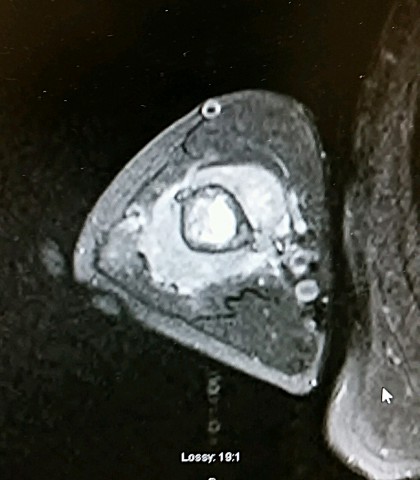
The plain radiographs are notable for the absence of any visible padgetoid changes in the affected area of the right distal femur. The initial radiographs were in fact read as normal. The most significant findings are on the MRI of the knee. There is a permeative lytic destructive process in the distal femur, involving most of the lateral femoral condyles and the distal portion of the femoral shaft, sparing a portion of the medial femoral condyle. The mass has expanded into the soft tissues slightly proximal and posterior to the patella, in the process transgressing the cortex of the anterior femur just proximal to the patella. There is a circumferential mass surrounding the distal femur. In the proximal tibia there is a round lesion, roughly the size of a quarter, in the marrow of the tibial plateau, which has signal abnormalities similar to the lesion in the proximal femur, and to my eye appears to be related to the lesion in the distal femur. I think this tibial focus represent a so-called skip metastasis or regional metastasis, or a separate marrow focus of disease if this turns out to be a marrow tumor. The x-rays are not very impressive in fact were read as normal. In retrospect, the radiologist added to comment that there was a slightly sclerotic abnormality in the distal femur, but this is pretty difficult to discern. The CT scan of the chest, abdomen, and pelvis are notable for multiple nodules in the left lung fields, and a few on the right as well. A lesion is seen in the manubrium which has bony destruction and a soft tissue extension. No mass is seen in the liver, and the rest of the abdominal CT is not remarkable.
Laboratory results:: 
No labs are requested.
Differential Diagnosis: 
The unimpressive plain radiograph results plus the permeative nature of the tumor, combined with the potential multiple sites of marrow involvement by this disease, favors the possibility of a tumor such as lymphoma or myeloma. However, with the patient's history, a Padget sarcoma must be considered. Other possibilities include an adenocarcinoma metastatic to the distal femur.
Further Work Up Needed:: 
A biopsy is clearly necessary. I think in order to establish without doubt the stage of disease, both the distal right femur lesion needs to be biopsied and the right proximal tibial lesion needs to be biopsied and these can be accomplished easily through a minimally invasive techniques.
Pathology results:: 
See the images.
Special Features of this Case:: 
The history of Padget's disease, liver failure, the patients age, and the appearance of the lesion point in different diagnostic directions. Will the orthopaedic treatment this patient needs vary according to the diagnosis or not?
Image Reference: 

An inherited disorder with bone fragility

Case Identification
Case ID Number: 
20090629HK
Periosteal Reaction: 
absent
Benign/Malignant: 
Benign
Clinical case information
Case presentation: 

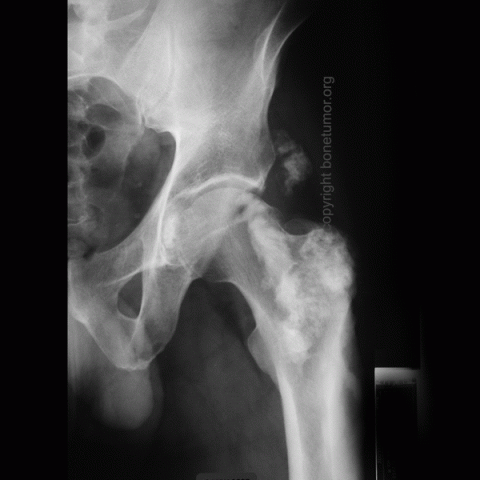
The patient is a 35-year-old woman who has pain in the top of the right proximal femur. The patient has a history of an inherited syndrome affecting growth and bone development.

Radiological findings:: 
She had precocious onset of sexual development. On examination the patient has short stature. There is a large café au lait spot over the right side of the neck and over the back. It has a regular border. See the xray images.
Laboratory results:: 
No contributory findings.
Differential Diagnosis: 
What is your differential diagnosis?
Treatment Options:: 
What should be done?

Angiosarcoma

An extremely aggressive sarcoma which typically presents with multifocal lesions in an anatomic region. This tumor may arise in association with a bone infarct or Paget's disease. High grade angiosarcoma seems to have two distinct clinical presentations. First, the lesion can present as multiple lesions in a single bone, two or more adjacent bones, or perhaps all the bones of a limb. These lesions seem to have an indolent course and the prognosis remains good. The second presentation is that of single or multiple rapidly progressive lesions that metastasize to other bones or to the lung this form of the disease has a very poor prognosis. This case illustrated the later type.

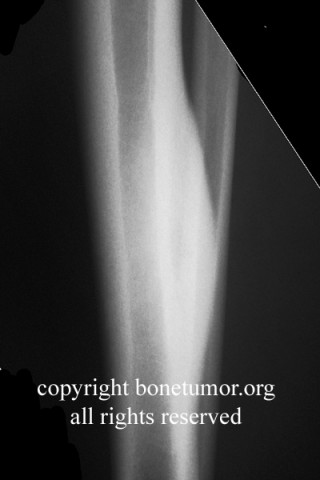
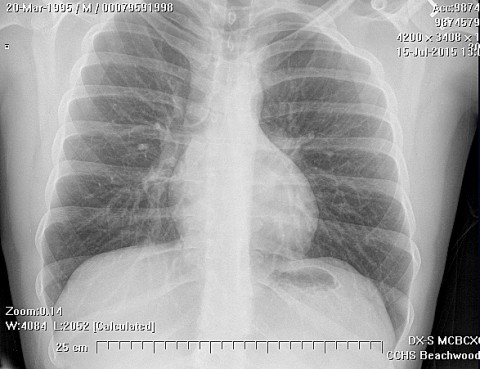
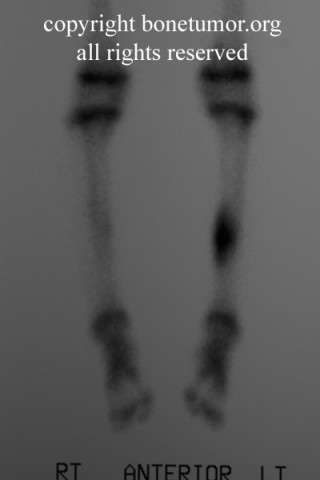
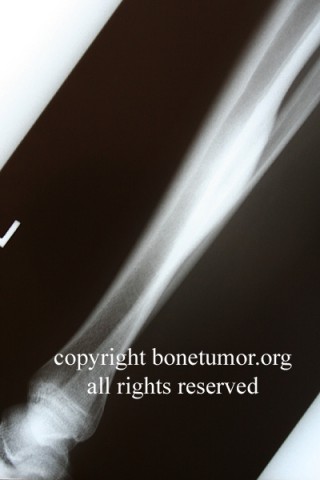
Patients present with increasingly severe bone pain. The radiographs shown here are of a 35 year old recently married auto mechanic whose wife had just had their first baby. He presented with severe pain in the distal femur. The initial work-up revealed multiple lesions in both lower extremities, including a lesion in the mid-diaphysis of the ipsilateral tibia and two lesions in the contralateral femur. A CT scan of the chest showed pulmonary nodules. Biopsy showed high-grade angiosarcoma of bone. Multiple, lytic, aggressive appearing lesions in a bone or adjacent bones.
Wide surgical resection and ajuvant therapy.

... Read Full Entry
Distribuir contenido